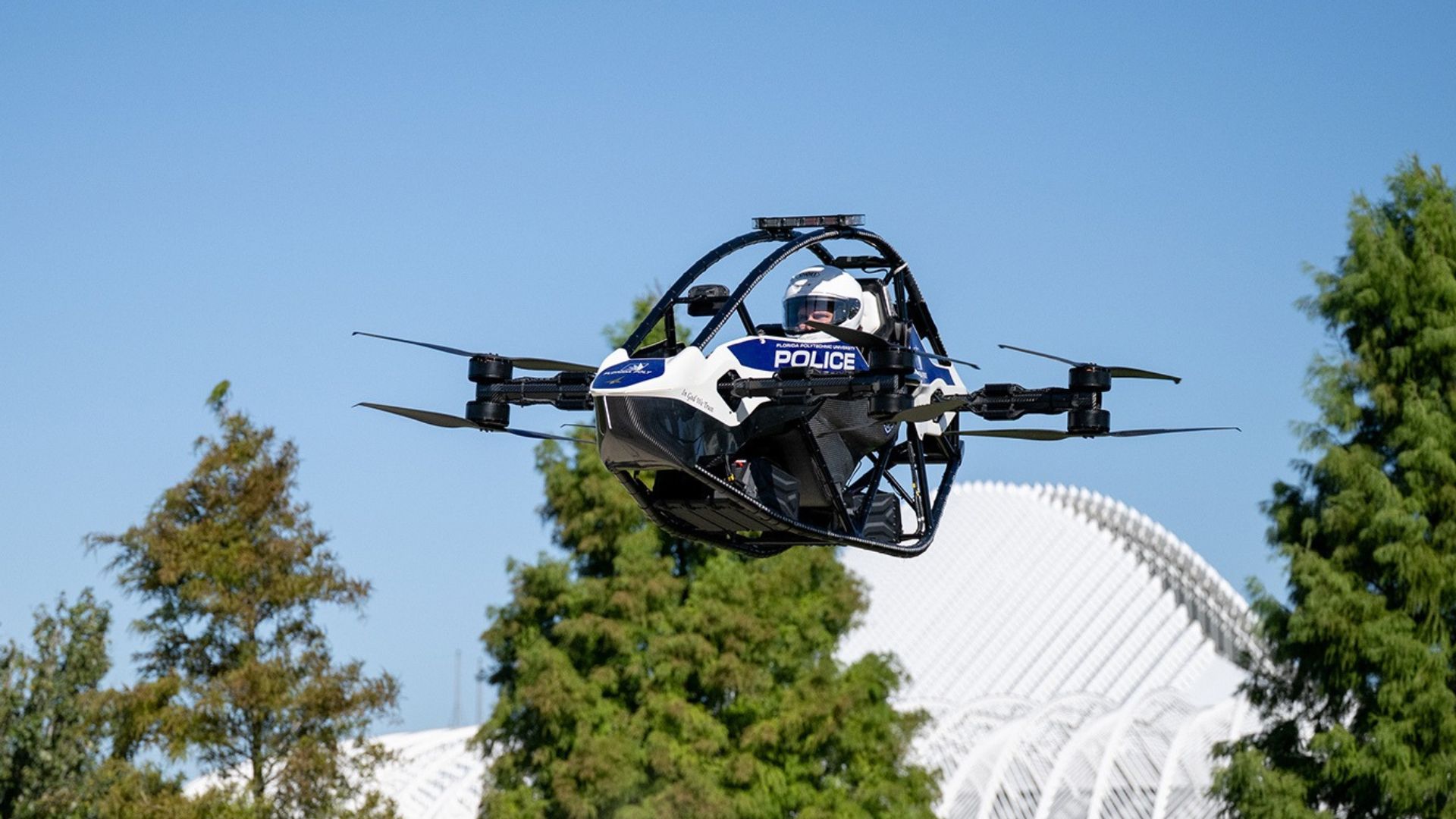
Florida Polytechnic University is set to deploy what it claims is America's first flying police vehicle, a piloted electric aircraft named Astro. Built on the Jetson ONE eVTOL platform, the vehicle boasts eight electric motors, a top speed of 63 mph, and a 20-minute flight time. While the university touts its potential for campus patrols and emergency response, the announcement has ignited a fiery debate over its practicality, safety, and broader implications for law enforcement.
A New Frontier in Aerial Policing
Astro’s introduction marks a significant step in the integration of advanced air mobility into public safety. Police Chief Aaron Murray highlights its ability to access hard-to-reach areas and assist in post-disaster operations. The university also plans to collaborate with regional law enforcement agencies, expanding its use beyond campus security.
Guess we can't use the phrase "When pigs fly!" anymore.
The aircraft’s deployment is pending Federal Aviation Administration (FAA) approval, a critical hurdle that will determine its operational timeline. Meanwhile, Florida Poly sees Astro as a research platform for its aerospace engineering program, offering students hands-on experience with emerging aviation technology.
Skepticism and Safety Concerns
Despite its innovative design, Astro has faced widespread skepticism. Critics question its limited flight time, weight restrictions (around 175 lbs), and exposed propellers, which could pose safety risks.
This is going to chop people up. Maybe bystanders, maybe criminals, maybe other cops, but it will run into people.
Others argue that the vehicle is a costly gimmick, with one commenter noting, "Complete waste of money as a police vehicle." The high cost of training and maintenance further raises doubts about its practicality for everyday policing.
Broader Implications and Alternatives
The debate extends beyond Astro’s immediate use. Some see potential in its application as an emergency medical transport, particularly in areas with poor infrastructure.
People might not like this as a police vehicle, but it could be good as EMT. A quick way to get to the hospital.
However, detractors point to existing police helicopters and fixed-wing aircraft, questioning the need for a new, smaller vehicle. One commenter quipped, "May I introduce you to the concept of police helicopters?"
A Glimpse into the Future?
Astro’s unveiling has sparked conversations about the future of law enforcement and aviation. While some view it as a dystopian development, others see it as a natural evolution of technology. Florida Poly’s initiative, whether successful or not, serves as a case study for the emerging advanced air mobility sector.
As the FAA’s decision looms, one thing is clear: Astro has already taken flight in the public imagination, leaving us to ponder the skies—and the role of technology—in shaping our future.

